
Showing all 4 results
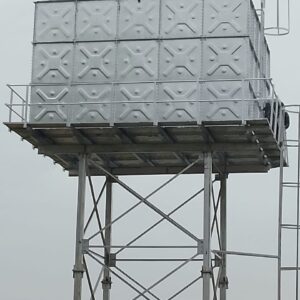
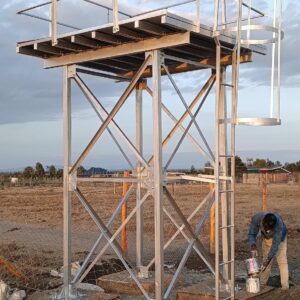
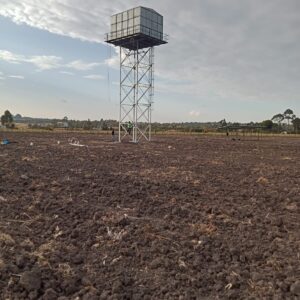
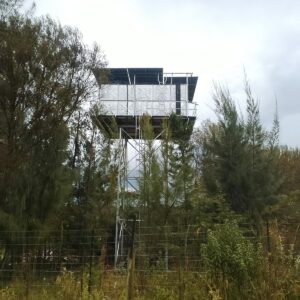
Water tank towers provide an elevated platform for storing water and distributing it through gravity.
They are used in residential developments, farms, schools, hospitals, commercial buildings, and industrial facilities where reliable water availability and suitable distribution pressure are important.
The design of a water tank tower depends on the storage tank’s capacity, required water pressure, installation height, ground conditions, and structural loading.
Selecting the appropriate tower involves more than choosing a height or the number of supporting legs; the entire structure must be designed to support the tank safely under the expected operating and environmental conditions.
At Steel Water Tanks Kenya, we provide steel water tank tower fabrication and installation solutions for residential, agricultural, commercial, institutional, and industrial projects across Kenya.
A water tank tower is a structural support system that raises a water storage tank above ground level. The elevation creates a difference in height between the stored water and the outlets below, allowing gravity to move water through connected pipes.
Water tank towers are particularly useful where buildings require gravity-fed distribution, where pumping needs to be reduced, or where stored water must remain available during certain power or supply interruptions.
A typical steel water tank tower may include structural columns, horizontal beams, cross-bracing, a tank support platform, access provisions, connection plates, anchor bolts, and foundations.
The configuration of these components depends on the tank dimensions, tower height, structural design, access requirements, and site conditions.
Water is pumped or otherwise supplied to the elevated tank. When an outlet is opened, gravity causes water to flow from the tank towards the connected plumbing system.
The available pressure depends primarily on the vertical difference between the water surface inside the tank and the point where water is delivered.
For a static water column, every metre of elevation produces approximately 9.81 kilopascals of pressure, equivalent to about 0.098 bar.
For example, a vertical water head of 10 metres produces approximately 0.98 bar of static pressure before accounting for losses in pipes, fittings, valves, and other components.
Actual pressure at an outlet may be lower because of friction, changes in elevation, pipe dimensions, and simultaneous water demand. Tower height should therefore be selected according to the required pressure at the point of use, rather than the tower height alone.
Water tank towers can help properties manage their water storage and distribution requirements, particularly where supply interruptions or insufficient gravity pressure affect daily activities.
Elevating a tank creates the potential for water distribution without continuous pumping. This can be useful for buildings and properties designed around gravity-fed plumbing.
Water can be pumped into the elevated tank when required and distributed later using gravity, provided the available water head meets the system’s requirements.
Pumping may still be necessary to replenish the tank or supply outlets located too high or too far away.
A tank containing sufficient stored water can continue supplying suitable gravity-fed outlets during a power interruption, as long as the water level remains high enough to provide the necessary pressure.
On appropriately designed sites, elevated storage can help distribute water to several buildings or outlets. The system must account for total demand, pipe losses, elevation differences, and peak consumption.
Farms, schools, healthcare facilities, hotels, and industrial premises may use elevated storage where it fits their water supply arrangement and operational requirements.
Water tank towers can be designed in several configurations. The appropriate arrangement depends on the tank load, height, available space, site conditions, and project requirements.
Four-leg towers use four main supporting columns connected by beams and bracing. Their suitability depends on the dimensions, loads, bracing arrangement, and structural design.
They may be considered for selected residential, agricultural, institutional, and commercial installations.
The tank capacity alone does not determine whether a four-leg tower is suitable. Column dimensions, connection details, platform design, wind exposure, and foundation conditions must also be evaluated.
Six-leg towers use six primary supports and an associated structural framing system. This configuration may be appropriate for certain larger platforms or project-specific loading arrangements.
Additional supports do not automatically make a tower safe or suitable for a particular tank. The complete structure must be analysed and designed for the actual loads and site conditions.
Industrial towers may support large tanks or specialised storage systems serving factories, processing facilities, institutions, and water distribution projects.
These structures may require more substantial columns, bracing, connections, access provisions, and foundations, depending on the design loads and installation environment.
Some projects require a tower designed around a specific tank diameter, installation height, available footprint, or distribution system.
Custom fabrication can accommodate project-specific dimensions, provided the final design is developed and checked by appropriately qualified structural professionals.
Tower height influences the available water pressure, structural demands, installation requirements, and overall project cost.
The correct height should be determined from the required pressure at the outlets, the elevation of those outlets, expected flow rates, and losses throughout the plumbing system.
A tower around six metres high may be considered for certain low-rise residential, agricultural, or small commercial applications.
Whether this height is sufficient depends on the water level in the tank and the elevation and pressure requirements of the connected outlets.
A tower around nine metres high may be suitable for selected properties that need additional gravity head.
Pipe dimensions, distribution distance, and simultaneous demand should be evaluated before confirming the design height.
Towers around twelve metres high may be considered for some institutional, commercial, or agricultural projects with higher pressure requirements.
Greater height also increases the importance of structural stability, wind loading, bracing, foundations, and safe access.
A tower around fifteen metres high may be considered for specialised water distribution projects where the required water head justifies the additional structure.
These installations require project-specific structural engineering and foundation assessment. They should not be selected solely because a particular tank capacity is being used.
The heights listed above are examples for preliminary planning, not universal recommendations for particular building types.
The tower must safely support the tank’s weight, the stored water, and all applicable structural and environmental loads.
Water weighs approximately one kilogram per litre. A tank containing 5,000 litres of water therefore holds approximately five tonnes of water, excluding the tank itself and the supporting structure.
The same principle applies to larger installations: a 10,000-litre tank contains approximately ten tonnes of water when full.
Typical capacity categories include:
These categories are indicative only. Two tanks with the same capacity may have different dimensions, shapes, support arrangements, and wind exposure, resulting in different structural requirements.
A steel water tank tower is a complete structural system in which each component contributes to stability and load transfer.
Columns carry loads from the tank support platform and transfer them towards the foundations. Their dimensions and material specifications depend on the design loads, height, restraint conditions, and structural analysis.
The beams and platform distribute the tank loads to the supporting columns. The arrangement must suit the tank base and provide appropriate support under the expected operating conditions.
Bracing helps resist lateral forces and limits unwanted movement of the structure. The configuration depends on the tower geometry, wind conditions, connections, and overall structural design.
Connections transfer forces between structural members and between the tower and its foundations. Their design is important to the stability and performance of the completed structure.
Foundations transfer structural loads to the ground. Their design depends on the loads from the tower, the ground’s bearing characteristics, settlement considerations, and site conditions.
Reinforced concrete foundations are common for steel tower installations, but their dimensions and reinforcement must be established through appropriate design rather than assumed from tank capacity alone.
Access ladders, platforms, handrails, and other safety provisions should be incorporated where required for inspection, cleaning, and maintenance. Their design must consider safe access and applicable working-at-height requirements.
The material and protective system affect the tower’s durability, maintenance requirements, and long-term performance.
Mild steel is widely used in structural fabrication because it can be cut, drilled, welded, and assembled into a variety of structural configurations.
Its suitability depends on the specified steel grade, member sizes, fabrication quality, and protective system.
Galvanization applies a zinc coating to steel to help protect it against corrosion. It may be suitable for certain tower components and environments, depending on the design and coating specifications.
Appropriate primers and protective coatings can help limit corrosion. Surface preparation, coating compatibility, application quality, and maintenance are important to their effectiveness.
The protective system should reflect local exposure conditions, including moisture, rainfall, airborne contaminants, and coastal environments where relevant. Inspection and maintenance plans help identify deterioration before it compromises the structure.
A properly planned project progresses from requirements assessment through design, fabrication, installation, and inspection.
The project team establishes the required tank capacity, installation height, site location, water demand, tank dimensions, and intended distribution arrangement.
Available space, access for delivery and lifting, and ground conditions are also considered.
Qualified structural professionals assess the loads and design the tower, connections, platform, and foundations.
The assessment considers the full tank load, structural self-weight, wind actions, stability, bracing, foundation conditions, and other relevant design requirements.
Fabrication may involve cutting steel members, drilling connection holes, preparing plates, welding components, assembling sections, and carrying out quality checks.
The fabrication procedures should follow the approved design and appropriate workmanship requirements.
Steel surfaces are prepared and treated with the specified protective system. The selection depends on the steel material, environmental exposure, and expected maintenance arrangements.
Foundation works are carried out according to the approved design and site requirements. Appropriate checks should be completed before the tower is erected.
The fabricated structure is assembled or erected using suitable lifting equipment, installation procedures, and temporary stability measures.
The tank is positioned and secured in accordance with its design and the tower’s support arrangement.
The completed installation is checked for conformity with the design, connection integrity, foundation requirements, tank support, and applicable safety provisions.
Water distribution components are then checked as appropriate before the system is placed into service.
The cost of a water tank tower depends on the complete project specification. Tower height and tank capacity are important, but they are not the only factors that determine the final quotation.
Key cost considerations include:
A project-specific quotation should clearly identify whether the price includes the tower only or also covers the tank, foundation, transportation, installation, and associated plumbing.
Farms may use elevated storage to supply livestock watering points, irrigation systems, greenhouses, and farm buildings. The design should reflect the required flow, distribution layout, and seasonal demand.
Residential installations may use elevated tanks to supply household outlets through gravity. The necessary water pressure depends on the plumbing arrangement and the elevation of the outlets.
Schools and institutional facilities may use elevated storage to distribute water to sanitation facilities, kitchens, accommodation blocks, and other buildings.
Hotels, apartment complexes, offices, and commercial properties may incorporate elevated tanks where gravity-fed distribution supports their water supply design.
Industrial facilities and community water schemes may require specialised towers for distribution to multiple outlets or buildings. Their design must reflect actual demand, operating pressure, and applicable safety requirements.
Choosing a contractor involves assessing more than the quoted price.
Consider whether the proposed solution accounts for the required tank capacity, structural design, site conditions, foundation requirements, corrosion protection, installation procedures, and maintenance access.
Ask for clarification on the scope of work, the materials specified, the structural design responsibility, and any inspections or documentation included in the project.
For elevated installations, structural design and foundation requirements should be addressed by appropriately qualified professionals before fabrication and construction proceed.
The appropriate height depends on the required pressure at the outlets, their elevation, pipe losses, and expected flow rates. A suitable height should be established from the water distribution design rather than using a fixed height for every property.
The cost varies according to tower height, tank capacity, steel specifications, foundation requirements, protective coatings, transportation, and installation scope. A reliable price should be based on the project’s actual requirements and an appropriate structural design.
Yes, provided the tower, platform, and connections are designed for the tank’s dimensions, support requirements, full operating weight, and applicable environmental loads. The tank manufacturer’s installation requirements must also be followed.
Service life depends on structural design, fabrication quality, corrosion protection, environmental exposure, and maintenance. Regular inspections and timely repairs can help maintain the structure’s condition over time.
The tower requires an appropriately designed foundation to transfer its loads safely to the ground. Reinforced concrete is commonly used, but the required foundation arrangement and dimensions depend on the structural design and site conditions.
A taller tower generally provides greater static water head, but the pressure available at an outlet also depends on the water level, outlet elevation, pipe friction, fittings, and flow demand. The correct height should meet the system’s requirements without introducing unnecessary structural cost.
Planning an elevated water storage system for a home, farm, school, apartment development, commercial property, or industrial facility?
Steel Water Tanks Kenya provides steel water tank tower fabrication and installation solutions tailored to project requirements. We can discuss your required tank capacity, preferred installation height, site conditions, and intended water distribution arrangement.
To request a quotation, provide your project location, tank capacity, approximate tower height, and whether you require the supporting tower alone or a complete tank and installation package.
Email: sales@steelwatertankskenya.co.ke
Phone: +254 714 138898
Contact Steel Water Tanks Kenya to discuss the requirements for your water tank tower project.