
Showing all 4 results
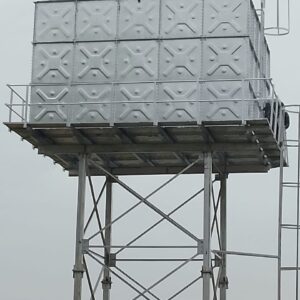
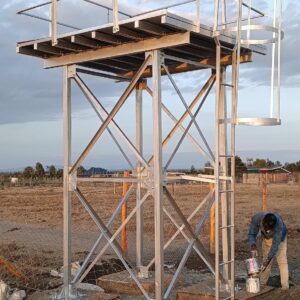
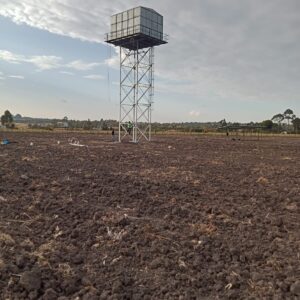
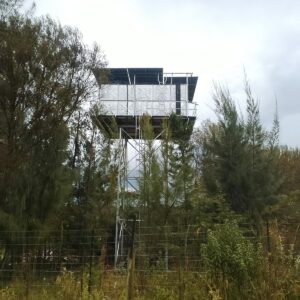
Steel water tanks provide durable, high-capacity water storage for residential developments, farms, schools, hospitals, factories, commercial buildings, and infrastructure projects across Kenya.
Their strength, flexible design options, and suitability for large-scale applications make them an important choice for projects that require reliable water storage.
As demand for dependable water supplies grows, property owners and businesses need storage systems that match their water consumption, site conditions, and long-term operational requirements.
Steel water tanks can be designed for ground-level installation, elevated storage, industrial use, and institutional water supply systems.
At Steel Water Tanks Kenya, we provide steel water tank fabrication, installation, and customised water storage solutions for agricultural, residential, commercial, and industrial projects throughout Kenya.
A steel water tank is a storage structure manufactured from steel plates or panels assembled to hold water safely. Depending on the intended application, tanks may be constructed using carbon steel with protective coatings, galvanized steel, or stainless steel.
Steel water tanks are available in different shapes, dimensions, and configurations to accommodate varying storage requirements. They can be installed at ground level, on engineered steel towers, or within larger water distribution systems.
The appropriate design depends on the required capacity, water quality, environmental conditions, structural loading, and installation location.
Water storage is important for properties that experience inconsistent water supply, depend on boreholes, harvest rainwater, or require substantial reserves for daily operations.
Steel tanks offer several advantages when correctly designed, fabricated, protected against corrosion, and maintained.
Steel provides a strong structural material for water storage applications. With appropriate engineering, reinforcement, and foundation design, steel tanks can accommodate substantial water volumes and demanding operating conditions.
Steel tanks can be manufactured or assembled to accommodate thousands or hundreds of thousands of litres of water. This makes them suitable for apartment developments, agricultural projects, institutions, industrial facilities, and community water supply systems.
Tank dimensions, configurations, and supporting arrangements can be adapted to suit individual projects. This flexibility is useful where standard tank sizes cannot meet the available space or required storage volume.
Steel tank walls are opaque, preventing direct sunlight from entering the storage vessel. When combined with suitable covers and hygienic design, this can help reduce conditions that encourage algae growth.
The service life of a steel water tank depends on its material, protective coating, water chemistry, installation environment, and maintenance. Appropriate corrosion protection and regular inspections help preserve the tank’s condition over time.
Different steel materials and construction methods are suited to different water storage applications. Understanding these options helps project owners select a system that meets their technical and budget requirements.
Galvanized steel tanks use steel protected by a zinc coating that helps reduce corrosion. Depending on the design, these tanks may be manufactured from galvanized sheets or assembled using galvanized steel panels.
They are commonly considered for agricultural water storage, commercial developments, institutional facilities, and other projects requiring substantial water capacity.
Important selection factors include coating quality, water chemistry, environmental exposure, and whether the tank is intended for drinking water. Potable water applications require materials and protective systems suitable for contact with drinking water.
Stainless steel tanks are manufactured from corrosion-resistant steel alloys. Their suitability depends on the specific grade, water chemistry, fabrication quality, and operating environment.
They may be considered for applications where hygiene, cleanability, or corrosion resistance is particularly important, including certain food processing and commercial facilities.
Stainless steel can be more expensive than other construction options, so material selection should reflect the actual requirements of the project.
Pressed steel tanks are assembled from prefabricated panels connected on-site using an appropriate bolted joint and sealing system.
Their modular construction can simplify transportation and make them suitable for large storage projects, particularly where moving a fully assembled tank would be difficult.
Panel dimensions, joint details, bracing, coatings, and installation procedures must be selected according to the tank’s design and intended operating conditions.
Welded steel tanks are fabricated by joining prepared steel plates to form the required vessel. They can be designed in different shapes and dimensions depending on the project.
These tanks may be suitable for industrial water storage, large commercial facilities, agricultural applications, and customised storage systems.
Proper welding procedures, inspection, surface preparation, protective coatings, and leak testing are important to the performance of the finished tank.
The appropriate tank capacity depends on the volume of water required, the reliability of the water source, and the number of days the stored supply should last.
For example, a building with an estimated daily water demand of 5,000 litres would require 10,000 litres of usable storage to cover two days without replenishment.
Actual tank selection should also account for usable capacity, operating levels, reserve requirements, and any specialised water demand.
The following examples illustrate how storage capacity may relate to different project types.
| Storage capacity | Potential application |
|---|---|
| 5,000 litres | Small properties and selected agricultural uses |
| 10,000 litres | Residential compounds and small commercial facilities |
| 20,000 litres | Larger residential properties and selected institutions |
| 30,000 litres | Commercial buildings and agricultural operations |
| 50,000 litres | Larger farms and institutional facilities |
| 100,000 litres and above | Industrial, commercial, and community water storage projects |
| 500,000 litres and above | Large infrastructure and municipal storage applications |
These are illustrative examples rather than fixed capacity recommendations. Actual requirements depend on water demand, supply reliability, site conditions, and project design.
Steel water storage systems serve a range of sectors, each with different requirements for capacity, water quality, installation, and distribution.
Residential properties use stored water for cooking, cleaning, bathing, sanitation, and other household activities. Apartment developments may require larger central storage systems to serve multiple households.
The storage arrangement should reflect expected occupancy, available water supply, distribution requirements, and anticipated future demand.
Farms may require water storage for irrigation, livestock, greenhouse production, and agricultural processing. The appropriate capacity depends on crop water requirements, livestock numbers, irrigation methods, and seasonal water availability.
For irrigation projects, the storage plan should be coordinated with the water source, pumping equipment, and distribution system.
Schools, hospitals, and other institutions need reliable water for sanitation, cleaning, kitchens, and daily operations. Some facilities also have specialised water quality or reserve requirements.
Tank capacity should be based on occupancy, operating schedules, water consumption, and the consequences of supply interruptions.
Hotels, offices, shopping centres, and mixed-use developments may require storage for guests, staff, cleaning, kitchens, and other building services.
Peak occupancy and operating requirements should be considered when estimating the required storage volume.
Factories and processing facilities may use stored water for manufacturing, equipment cleaning, cooling, and other operational purposes.
Industrial projects require careful consideration of water quality, process requirements, material compatibility, and any applicable safety standards. Fire protection storage, where required, should be designed according to the relevant fire safety requirements.
A successful water storage project involves more than manufacturing the tank. The design, materials, supporting structure, installation, and testing must all be suitable for the intended application.
The initial assessment establishes the required storage capacity, site conditions, water source, installation arrangement, and intended use.
This information helps determine the appropriate tank configuration and the work required before installation.
The tank and any supporting tower or foundation should be designed for the relevant loads and environmental conditions.
For elevated installations, the design should account for the full weight of stored water, the tank itself, wind loading, structural stability, foundation conditions, and other applicable design requirements.
Depending on the selected construction method, fabrication may involve cutting steel plates, forming components, preparing panel connections, welding, fitting reinforcement, and assembling structural elements.
Quality control during fabrication helps ensure that the finished tank conforms to its design specifications.
Steel requires a suitable protective system to limit corrosion. Depending on the tank material and intended use, this may involve galvanization, compatible industrial coatings, or an appropriate internal lining.
The coating system should be suitable for the water being stored and the environment in which the tank will operate.
Installation includes preparing the site, positioning or assembling the tank, connecting the required pipework, and completing the supporting works.
Before commissioning, appropriate inspections and water-tightness tests should be performed. Elevated installations should also be checked against the relevant structural and safety requirements.
The cost of a steel water tank varies according to the specifications of the project. A reliable quotation should reflect the complete scope of work rather than capacity alone.
Important cost factors include:
Because these variables differ from one project to another, it is advisable to request a quotation based on the intended capacity, installation location, materials, and required services.
Steel and plastic tanks serve different water storage needs. The most suitable option depends on the required capacity, budget, installation conditions, and expected service life.
| Feature | Steel water tanks | Plastic water tanks |
|---|---|---|
| Structural characteristics | Suitable for engineered, large-capacity systems | Suitable for many standard storage applications |
| Capacity options | Can accommodate very large volumes | Commonly available in standard residential sizes |
| Customisation | Can be fabricated or configured for specific projects | Depends on available products and manufacturing methods |
| Installation | May require specialised assembly or lifting | Often simpler for smaller tanks |
| Corrosion and degradation | Requires appropriate corrosion protection where applicable | Not subject to steel rust, but can degrade with unsuitable exposure or materials |
| Maintenance | May require coating inspections and repairs | Requires inspection for damage, leakage, and material deterioration |
| Elevated installation | Possible with a suitably engineered support structure | Possible when the tank and support arrangement are designed for the application |
Neither material is automatically best for every project. Selection should be based on the specific storage requirements and the total cost of installation, maintenance, and operation.
Selecting an appropriate tank supplier and fabrication team is an important part of planning a reliable water storage system.
Steel Water Tanks Kenya provides water storage solutions for residential, agricultural, commercial, institutional, and industrial applications. Our services include steel tank fabrication, installation, and elevated water tower solutions tailored to project requirements.
We work with customers to understand their required capacity, site conditions, installation arrangements, and intended use before determining the appropriate project scope.
Whether you are planning storage for a farm, apartment development, school, commercial building, or industrial facility, the first step is to establish your water demand and installation requirements.
Service life depends on the steel type, coating system, water chemistry, environmental exposure, workmanship, and maintenance. Properly designed and maintained tanks can provide many years of service, but a specific lifespan should not be assumed without considering these conditions.
Yes, when the tank materials, internal coatings, seals, fittings, and overall design are suitable for potable water. The water itself must also be protected against contamination during storage and distribution.
Galvanized steel uses a zinc coating to protect the underlying steel against corrosion. Stainless steel relies on the corrosion-resistant properties of its alloy. The better option depends on the water chemistry, environment, hygiene requirements, budget, and intended service conditions.
Yes. An elevated tank can support gravity-fed water distribution when the height and plumbing system provide adequate pressure. The tower and foundation must be designed by qualified professionals to safely support the tank, stored water, and applicable environmental loads.
Useful information includes the required storage capacity, project location, intended use, preferred tank type, installation height, and whether you need fabrication only or a complete installation. Site information and project drawings can also help establish the scope of work.
Planning a water storage project for a residential development, farm, school, commercial property, or industrial facility?
Steel Water Tanks Kenya can help you discuss the requirements for steel tank fabrication, water storage, installation, and elevated tank structures.
Contact our team to explain your project and request a quotation based on your specific requirements.
Email: sales@steelwatertankskenya.co.ke
Phone: +254 714 138898
Share your location, required storage capacity, intended application, and installation requirements so we can better understand your project.
Steel Water Tanks Kenya provides water storage solutions designed around your project’s needs.